 Serge Belov
The simplest AI business case for a contact center comes down to one line: the bot will handle 30% of contacts, so we'll need 30% fewer agents.
You can check that line with a calculator before you sign anything, and it doesn't hold up. A bot doesn't take a random 30% of your contacts. It takes the easy ones, and the calls it leaves behind run longer on average.
Here's an example. I made up the queue, but the math is real.
The queue before AI
Say you get 500 contacts in a half hour with a 5:00 average handle time, and you want 80% answered in 20 seconds. Erlang C says 91 agents on the phones, before shrinkage.
The bot goes live and resolves 30%. That leaves 350.
| Scenario | Contacts per half hour | Handle time | Agents needed |
|---|---|---|---|
| Today | 500 | 5:00 | 91 |
| AI takes 30%, handle time unchanged | 350 | 5:00 | 65 |
| AI takes 30%, remaining contacts run longer | 350 | 6:20 | 82 |
The business case says 65. The queue needs 82. You were promised 26 agents back and you got 9.
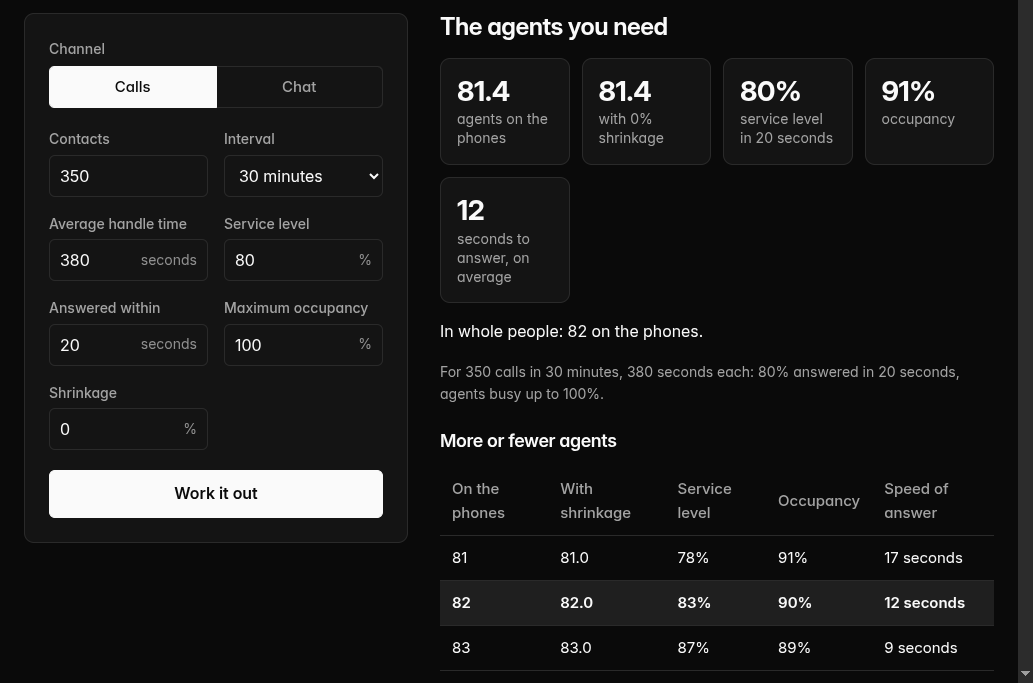
That's the 82 from the table, in the free Erlangly calculator. Open this example and choose Work it out to see it yourself.
Where 6:20 comes from
You don't need a pessimistic assumption to get there. Say the 150 contacts the bot picks up used to average a little under two minutes each, things like password resets and order status. Pull those out and the average of what's left is 6:20. Nobody's call got any longer. You just stopped counting the short ones.
Then there's the customer who tried the bot first, got nowhere, and reached your agent annoyed. I'd expect those calls to run longer too, which would eat further into the saving. How much depends on your bot and your customers, so measure it.
Small changes in handle time move this a lot
Keep the 30% and change only the handle time:
| Handle time after AI | Agents needed |
|---|---|
| 5:00 | 65 |
| 5:40 | 74 |
| 6:20 | 82 |
| 7:00 | 90 |
At 7:00 you've automated almost a third of your contacts and saved one agent.
A smaller rollout can do even worse. If the bot takes 10% of contacts and handle time goes from 5:00 to 5:30, you still need 91 agents. You paid for a bot and your staffing didn't change.
If you staff to the simple math anyway
The real workload here is about 74 agents' worth of continuous talk time. Put 65 people on it and you're asking for 114% utilization, which can't happen. The queue keeps growing until customers hang up.
I'd worry about this more than the budget miss. The likely order of events is that you announce the savings, reduce headcount, and then watch service level fall apart.
What I'd do instead
Start by measuring handle time by contact reason, so you know how long the contacts you plan to automate really take. They're probably shorter than your average, and that's the entire problem.
Forecast bot-handled and human work separately, because a single blended volume forecast hides the change in mix. When you rerun staffing, change volume and handle time together. Changing only volume is how you get to 65.
Count escalations from the bot as human work, with their own handle time. And run the numbers at a few different handle times, then check them against a real pilot before you touch headcount.
To try your own numbers, change the inputs in the free Erlang C calculator.
Erlang C has limits. It ignores abandons and assumes steady arrivals, so use it for planning, and remember your scheduled headcount will be higher once you add shrinkage. The gap between 65 and 82 doesn't go away because of any of that.
Disclosure: I co-founded Erlangly, which makes that calculator. If you want to go through this with your own numbers, book a free call.